
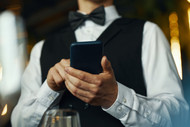
Snapshot
- The iPhone XR remains a cost-effective mobility option for hospitality iPhone solutions, including guest services and staff operations.
- Hotels and resorts use iPhone XR units for front desk check-ins, housekeeping coordination, and guest engagement.
- The device balances affordability and performance, making iPhone XR hotel deployment ideal for high-churn hospitality workforces.
- MDM integration enables seamless provisioning, ensuring devices can be reassigned quickly across staff shifts.
- Accessories and rugged cases extend the XR’s usability in fast-paced hotel and restaurant environments.
- Case studies confirm that the iPhone XR improves service response times, guest satisfaction, and operational efficiency.
Executive Summary
The hospitality industry thrives on service excellence, speed, and seamless guest experiences. To meet these demands, hotels, resorts, and restaurants increasingly rely on mobile devices to power staff operations. The iPhone XR hospitality industry applications profile makes it a compelling choice for enterprises seeking affordable yet capable mobility solutions for large-scale deployment.
The iPhone XR is not Apple’s latest device, but its balance of performance, affordability, and ongoing iOS support positions it as a strong enterprise option. Its use in iPhone XR hotel deployment scenarios includes front desk guest check-ins, housekeeping coordination, room service management, and concierge services. Hotels deploying XR fleets can standardize staff workflows, reduce reliance on outdated hardware, and improve communication across departments.
Importantly, the XR remains cost-effective. Bulk procurement pricing often places the XR in the $200–$300 range, enabling hotels and resorts to outfit large frontline teams without straining budgets. Paired with accessories and MDM management, the device provides hospitality iPhone solutions that improve response times, enhance guest experiences, and strengthen staff productivity.
This article explores how the iPhone XR supports hospitality operations, from front desk to housekeeping to concierge services. It analyzes deployment strategies, ROI, risks, and long-term value, making it a roadmap for CIOs, hotel executives, and operations managers.
Table of Contents
- Market Context: Mobile Devices in Hospitality
- The Role of iPhone XR in Hotel & Guest-Facing Workflows
- Deployment Strategies: Front Desk, Housekeeping & Concierge
- Financial Modeling: Cost Efficiency & Lifecycle ROI
- Case Studies: iPhone XR Hospitality Deployments
- Risks & Mitigation in Hospitality Environments
- Accessory & Warranty Bundling for Hotel Fleets
- ROI & Future Outlook for Hospitality iPhone Solutions
- FAQs for Hospitality IT & Operations Leaders
- Conclusion
Market Context: Mobile Devices in Hospitality
The hospitality industry is undergoing a digital transformation, with mobile devices at the center of guest service innovation. Guests now expect instant responses, mobile check-ins, and seamless digital interactions during their stays. To meet these demands, hotels and resorts are deploying mobile devices not only for staff productivity but also as tools for direct guest engagement.
iPhones, in particular, are widely used due to their ecosystem reliability and enterprise security. Unlike fragmented Android deployments, iPhones allow hotels to standardize device fleets across departments. This improves IT management efficiency, ensures consistent app compatibility, and reduces security risks.
The iPhone XR hospitality industry applications fit this environment well. Though launched in 2018, the XR remains a capable device for hospitality workflows. Its large display and reliable performance make it ideal for customer-facing roles, while its lower bulk pricing allows large-scale deployments at a fraction of the cost of newer iPhones.
Hotels have begun deploying XR devices for front desk check-ins, mobile concierge services, and housekeeping coordination. With MDM integration, devices can be reassigned across shifts or departments quickly, ensuring optimal usage.
Takeaway: The hospitality market’s demand for mobile-first service delivery positions the iPhone XR as a cost-efficient, reliable tool for guest-facing and staff-facing hotel workflows.
The Role of iPhone XR in Hotel & Guest-Facing Workflows
The Apple iPhone XR hotel deployment profile demonstrates how one device can streamline multiple hospitality functions, enhancing both guest satisfaction and staff efficiency.
Front Desk & Check-In: Staff equipped with iPhone XR devices can handle mobile check-ins, process payments, and issue digital room keys. This reduces wait times at the front desk and enhances the guest arrival experience.
Housekeeping Coordination: Housekeeping staff use XR devices to receive task assignments, update room statuses, and communicate with supervisors in real time. This reduces delays in room turnovers and improves operational efficiency.
Concierge & Guest Engagement: iPhone XR devices enable concierges to manage guest requests, provide local recommendations, and book reservations on the spot. Apps also allow staff to communicate directly with guests through secure messaging, improving personalization.
Food & Beverage Services: In restaurants and bars, servers can use XR devices to take orders, process mobile payments, and communicate with kitchens. This speeds up service and reduces order errors.
Maintenance & Support: Engineering teams use XR devices to receive repair requests, log work orders, and update status reports. Integration with property management systems ensures fast response times to guest-reported issues.
Takeaway: By consolidating check-in, housekeeping, concierge, food service, and maintenance into one device, the iPhone XR serves as a multi-role tool that elevates both guest experience and staff productivity.
Deployment Strategies: Front Desk, Housekeeping & Concierge
Deploying iPhone XR fleets in hospitality requires mapping device capabilities to department-specific needs. A tiered deployment strategy ensures the right workflows are supported while keeping costs under control.
Front Desk & Guest Services
At the front desk, speed and professionalism are key. iPhone XR devices can be paired with POS terminals or mobile card readers to process payments, check guests in, and issue digital keys. Staff can also use them to manage overbooking, upsell rooms, and send guest notifications. For high-volume hotels, mobile-enabled front desk staff reduce lines and improve guest satisfaction scores.
Housekeeping & Facilities
Housekeeping staff benefit significantly from iPhone XR hotel deployment. Using property management apps, staff can update room status in real time, log missing amenities, and report maintenance issues. This minimizes delays in room turnover and increases operational efficiency. Facilities teams can also track preventive maintenance tasks and respond faster to urgent requests.
Concierge & Guest Interaction
Concierge teams use XR devices as mobile service hubs. Through apps integrated with local attractions, restaurants, and transportation services, concierges can book reservations, arrange tours, and message guests directly. The ability to provide on-the-spot service elevates guest experiences and drives higher satisfaction scores.
Food & Beverage
Restaurants, cafes, and bars within hotels often deploy iPhone XR units as mobile ordering devices. Staff can transmit orders directly to kitchens, manage tabs, and process payments tableside. This reduces wait times and improves order accuracy.
Management & Oversight
Supervisors and department heads can monitor team activity, review task completion, and communicate with staff through XR units. With MDM, managers can enforce role-based access controls, ensuring each device is configured for its specific department.
Takeaway: A role-based deployment ensures that iPhone XR devices are strategically assigned, turning them into department-specific productivity tools that optimize guest experience and staff performance.
Financial Modeling: Cost Efficiency & Lifecycle ROI
The iPhone XR hospitality industry applications model shines when looking at cost efficiency over lifecycle. Bulk procurement pricing makes the XR one of the most cost-effective iPhones for enterprise-scale hospitality deployments.
Acquisition Costs:
In wholesale channels, iPhone XR units typically cost $200–$300 per device, depending on grade (A, B, etc.). This makes them far more affordable than newer iPhones priced between $600–$1,000. For hotels needing thousands of devices, this pricing creates immediate capital savings.
Depreciation & Residual Value:
Even as an older model, the XR retains ~30–35% of its value after 24 months. Enterprises that refresh on a two-year cycle can recoup part of their investment through trade-ins or cascading units to non-critical roles (e.g., training or back-office).
ROI Example – 1,000 Device Deployment (24-Month Cycle):
|
Device Model |
Acquisition Price |
Residual Value |
Net Cost per Unit |
Fleet Net Cost |
|
iPhone XR |
$250 |
$85 (34%) |
$165 |
$165,000 |
|
iPhone 12 |
$400 |
$150 (38%) |
$250 |
$250,000 |
|
iPhone 13 |
$650 |
$325 (50%) |
$325 |
$325,000 |
Takeaway from Table: The iPhone XR delivers the lowest net cost of ownership per unit, making it ideal for high-volume hotel deployments where staff turnover and device reassignments are frequent.
Support Costs:
Hospitality environments are demanding, with devices exposed to spills, drops, and constant handling. Pairing XR fleets with rugged cases and AppleCare Enterprise adds predictable support costs while minimizing downtime.
Lifecycle Economics:
With Apple’s iOS support extending several more years for the XR, enterprises can deploy with confidence for 24–30 months in frontline roles before cascading devices into less critical functions.
Takeaway: The iPhone XR offers the best ROI for cost-conscious hospitality enterprises, balancing affordability with reliable enterprise performance.
Case Studies: iPhone XR Hospitality Deployments
Case Study 1 – International Hotel Chain
A global hospitality brand deployed 20,000 iPhone XR units across properties. Devices were assigned to front desk staff, housekeeping, and concierge teams. The chain reported a 22% reduction in check-in times and improved guest satisfaction scores across all regions.
Case Study 2 – Boutique Luxury Resort
A resort issued iPhone XR units to concierge staff for mobile guest interactions. By using CRM-integrated apps, concierges were able to upsell spa treatments and tours at the point of conversation. This led to a 15% increase in ancillary revenue per guest.
Case Study 3 – Large Convention Hotel
A convention hotel with 1,200 rooms deployed XR devices to housekeeping and maintenance staff. Real-time task assignment reduced average room turnover times by 18 minutes, allowing for faster guest check-ins during peak conference events.
Case Study 4 – Restaurant Group in Hospitality Sector
A hospitality group operating hotel restaurants deployed iPhone XR units for tableside ordering and payments. This reduced average service times by 12% and improved customer satisfaction ratings.
Takeaway: Case studies highlight how iPhone XR units can be adapted across diverse hospitality environments, improving efficiency, generating revenue, and strengthening guest satisfaction.
Risks & Mitigation in Hospitality Environments
The hospitality sector is fast-paced, high-touch, and service-driven, which exposes mobile devices to unique risks. The iPhone XR hotel deployment model must account for these realities to ensure uptime and guest satisfaction.
High Device Turnover: Hospitality roles, particularly housekeeping and seasonal staff, experience high churn. Frequent reassignments increase the risk of misconfiguration or data exposure.
- Mitigation: Use MDM and Apple Business Manager for rapid device wiping and provisioning, ensuring each device is secure when reassigned.
Physical Damage Risks: Devices are exposed to spills, drops, and heavy daily use. Housekeeping carts, kitchens, and poolsides are all high-risk zones.
- Mitigation: Deploy rugged cases, waterproof protectors, and charging carts to reduce breakage and extend lifespan.
Battery Strain: Long shifts in housekeeping or food service mean devices may run out of power mid-shift.
- Mitigation: Provide extended battery cases, hot-swap charging docks, or shared-device models to ensure 24/7 availability.
Guest Data Security: Front desk and concierge staff handle sensitive guest data, including payment information and loyalty program details. Lost or stolen devices present data privacy risks.
- Mitigation: Enforce biometric authentication, VPN-secured connections, and remote wipe capabilities through MDM.
Perception Risks: In luxury hotels, guests expect staff to use professional, high-quality tools. Devices with visible cosmetic damage may undermine brand image.
- Mitigation: Assign higher-grade iPhone XR units (A or A/B stock) to guest-facing staff, reserving lower-grade units for back-of-house roles.
Takeaway: Risks in hospitality deployments are manageable with structured provisioning, protective accessories, and role-based grade deployment.
Accessory & Warranty Bundling for Hotel Fleets
To maximize ROI, hospitality iPhone solutions must include robust accessory strategies and warranty coverage.
Essential Accessories:
- Ruggedized cases & waterproof protectors: Protect against drops, spills, and humidity.
- Antimicrobial covers: Reduce bacteria transmission, especially important in food service and housekeeping.
- Charging carts & docking stations: Enable efficient shift-based device sharing and ensure full charge availability.
- POS and payment attachments: Allow iPhone XR devices to function as mobile POS units in restaurants, bars, and front desks.
- Bluetooth scanners: Extend device use for inventory management in hotel shops and storage rooms.
Warranty Strategies:
- AppleCare Enterprise provides next-day replacements, which are critical in hospitality where downtime directly affects guest service.
- Third-party coverage can be added for accidental damage and liquid exposure, both common in hotel environments.
- Swap pools (5–10% spare devices) help ensure uninterrupted service when units are damaged or lost.
ROI Example – Hotel Group Fleet (3,000 Units):
- Bulk iPhone XR Purchase: $750K ($250 each)
- Accessories & AppleCare: $300K
- Total Investment: $1.05M
- Without coverage: downtime & repair costs ~$500K annually
- With coverage: ~$180K annually
- Net savings: $320K annually, plus stronger operational resilience.
Takeaway: Accessories and warranty bundles transform iPhone XR fleets from fragile assets into reliable service enablers for hotels and resorts.
ROI & Future Outlook for Hospitality iPhone Solutions
The iPhone XR hospitality industry applications model delivers strong ROI by reducing capital investment while maintaining performance for guest-facing roles.
ROI Drivers:
- Affordable acquisition costs (40–60% lower than newer models).
- Reduced hardware redundancy by consolidating POS, communication, and task management into one device.
- Faster guest service and reduced wait times, driving higher guest satisfaction and repeat bookings.
- Residual value recovery after 24–30 months, further lowering lifecycle costs.
Future Outlook:
With continued iOS support for several more years, the iPhone XR remains a viable hospitality solution through at least 2025–2026. Enterprises can cascade XR units from guest-facing roles to training or back-office roles as newer devices are introduced.
The hospitality industry is also adopting digital-first guest engagement strategies (mobile check-in, mobile concierge, digital room keys). iPhone XR fleets align well with these trends, providing a scalable and affordable platform for service transformation.
Takeaway: iPhone XR deployments will remain an important part of hospitality iPhone solutions, especially for hotels balancing guest satisfaction goals with budget constraints.
FAQs for Hospitality IT & Operations Leaders
- Why choose the iPhone XR over newer models for hospitality?
The iPhone XR offers a balance of affordability and performance that makes it ideal for hospitality environments with high device volumes and frequent staff turnover. While newer iPhones provide incremental improvements in camera or processing power, most hospitality workflows—such as check-ins, task management, and mobile POS—are fully supported by the XR. Its lower cost per unit makes large-scale deployment feasible without compromising functionality. - How does the iPhone XR improve guest satisfaction in hotels?
By enabling mobile check-ins, real-time housekeeping updates, and concierge guest messaging, the iPhone XR allows staff to respond to guest needs faster and more efficiently. Faster check-in lines, quicker room turnovers, and personalized concierge services all contribute to higher guest satisfaction scores. For hotels, this directly translates into stronger loyalty and repeat business. - What risks should hotels consider when deploying iPhone XR fleets?
The main risks are physical damage (drops, spills, humidity), device loss due to high staff turnover, and shorter long-term support compared to newer models. These risks can be mitigated by rugged accessories, MDM policies for security and provisioning, and structured refresh cycles of 24–30 months to ensure performance. - How does iPhone XR compare to Android devices for hospitality deployments?
While Android devices are often cheaper upfront, they vary widely in build quality, security, and lifecycle support. The iPhone XR provides a consistent ecosystem, long iOS support, and seamless integration with enterprise MDM systems. For IT leaders managing multi-property operations, this consistency reduces complexity and lowers long-term costs. - What warranty and support strategies work best for iPhone XR hotel deployments?
The most effective approach is pairing iPhone XR units with AppleCare Enterprise for rapid replacements, supplemented by rugged cases and swap pools. This ensures devices are always available for guest-facing staff. Third-party warranties may also be used to cover accidental or liquid damage, which is common in hospitality settings. - Is the iPhone XR still viable for 3–5 years of hospitality use?
Yes. The XR continues to receive iOS updates and will remain viable for at least another 2–3 years in frontline roles. With proper lifecycle management, enterprises can use XR units in guest-facing roles for 24–30 months, then cascade them to back-office or training functions for an additional 12–18 months, extending usable lifespan up to 4 years.
Conclusion
The iPhone XR hospitality industry applications case proves that mobility investments do not always require the latest device models. By standardizing on the XR, hotels, resorts, and restaurants gain a cost-effective, multifunctional platform that supports front desk, housekeeping, concierge, and food service workflows.
Through smart deployment strategies, accessory bundles, and structured lifecycle management, enterprises can achieve strong ROI while delivering better guest experiences. The iPhone XR remains one of the most practical and scalable hospitality iPhone solutions for enterprises balancing performance demands with budget constraints.
Search this blog

Other Posts
-
Stock Grade Education & Quality
-

Motorola Edge Healthcare Solutions: Clinical Documentation
-

Motorola Government Solutions: Secure Communications
-
Motorola Hospitality Solutions: Staff Communication Systems
-

Motorola Logistics Applications: Warehouse Operations
-

Motorola Moto G Education Programs: Student Device Solutions